

Behind every day of care is a story worth sharing. “Care Diary” brings together meaningful moments from our participants, families and staff at H&H Care SA, celebrating connection, dedication and the quiet sacrifices made for loved ones. Through these stories, we hope to inspire kindness, share lessons and remind everyone who cares for others that their wellbeing matters too. Even the smallest act of care can make a lasting difference—and no one should have to care alone.
Choose an Article.
I’d Rather Carry the Burden Than Have My Children Carry It
“I’d Rather Carry the Burden Than Have My Children Carry It”
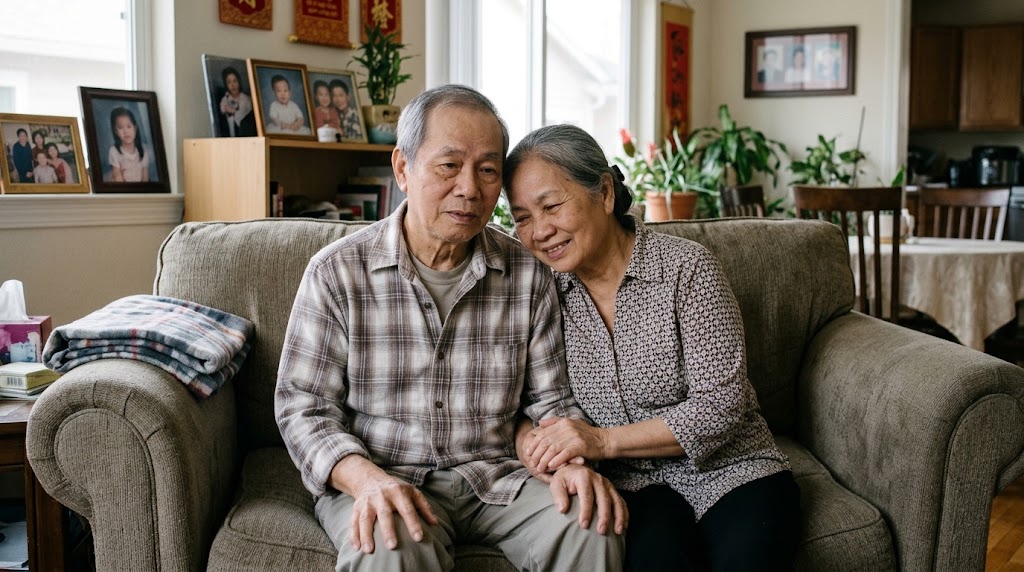
Some stories of care make us pause. Behind every meal prepared and every interrupted night’s sleep is a depth of love—and an exhaustion—that others may never see.
They once ran a thriving farm together. Years of hard work had brought them a comfortable life. Their children had grown up, become independent and remained close to their parents. It seemed they had reached a time when they could ease their workload, enjoy each other’s company and spend more time with their grandchildren.
Then, just over a year ago, he had a stroke while working.
From that day, life changed for the whole family.
She stepped away from their successful business to care for him. Throughout his hospital stay and after he returned home, she looked after her husband while taking responsibility for everything else at home. The partner who had once shared her work and worries now needed her help with everyday life.
The physical care was only part of what made it difficult. Before the stroke, he had been gentle and easy to get along with. Afterwards, he became more irritable and easily frustrated. Unable to speak, he had to express his wishes through his eyes and gestures, which were often difficult to interpret.
Sometimes, support workers would watch carefully and ask questions, trying to understand what he needed. Still, they could not work it out.
But she understood.
Perhaps that understanding came from their years together—from knowing his smallest habits and watching him patiently every day. When words could no longer express his wishes, she helped others understand him.
Yet understanding him did not mean she felt no pain or exhaustion.
Once, during an angry moment, he pushed her and she fell, leaving her leg bruised and her body aching. She brushed it off with a small smile and continued caring for him. For those around her, that smile was heartbreaking.
Her injuries should never become something she is expected to quietly accept. She deserves protection, understanding and practical help to keep them both safe. Her love for him matters, and so does her safety.
Each day, she carefully prepares his meals. He is particular about food and does not like eating the same dishes again, so she keeps looking for different things to cook. To someone else, it may look like just another meal. For her, it represents time spent thinking, preparing and hoping he will eat a little more.
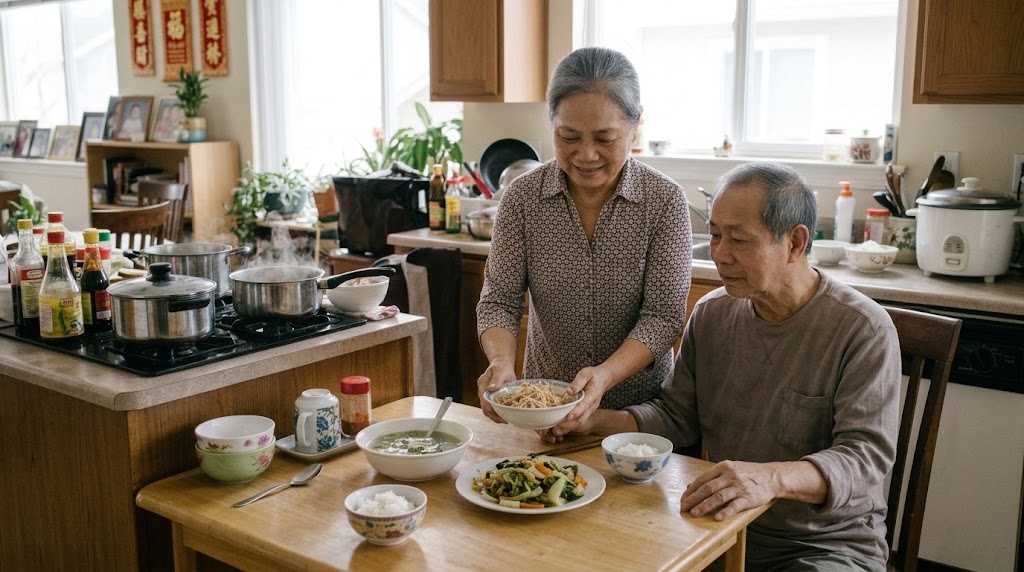
Support workers care for him for eight hours a day. That help is valuable. But when their shifts end, she remains, caring for him through the hours that follow.
A support worker’s shift has a handover. A wife’s worries can follow her into sleep.
She is often tired and short of sleep from attending so closely to his needs. Yet when her grandchildren visit, she still makes time to care for them. With so much already on her shoulders, she continues to be a loving grandmother and a mother who wants her children to know that things are all right.
Someone once asked her:
“Why don’t you rest and look after yourself? Why keep working so hard?”
She replied:
“If I don’t look after him, my children will have to. I’d rather carry the burden than have them carry it.”
Such simple words, yet so difficult to hear without feeling a lump in your throat.
She cares for her husband because she loves him. She takes on the hard work because she loves her children too. In her mind, as long as she can keep going, they will have one less worry and more time to care for their own families.
In her, we recognise the quiet devotion of so many Vietnamese women: loving their husbands and children, and often placing themselves last. That devotion deserves respect. But even the most devoted person has limits. She has a body that needs rest, health that needs attention and needs of her own.
Admiring her strength must lead to more than simply watching her struggle on.
What she needs may be something practical: someone to take over so she can sleep properly; a meal prepared for her; time to attend her own medical appointments; or someone who sits beside her, asks how she is really feeling and stays to hear the answer.
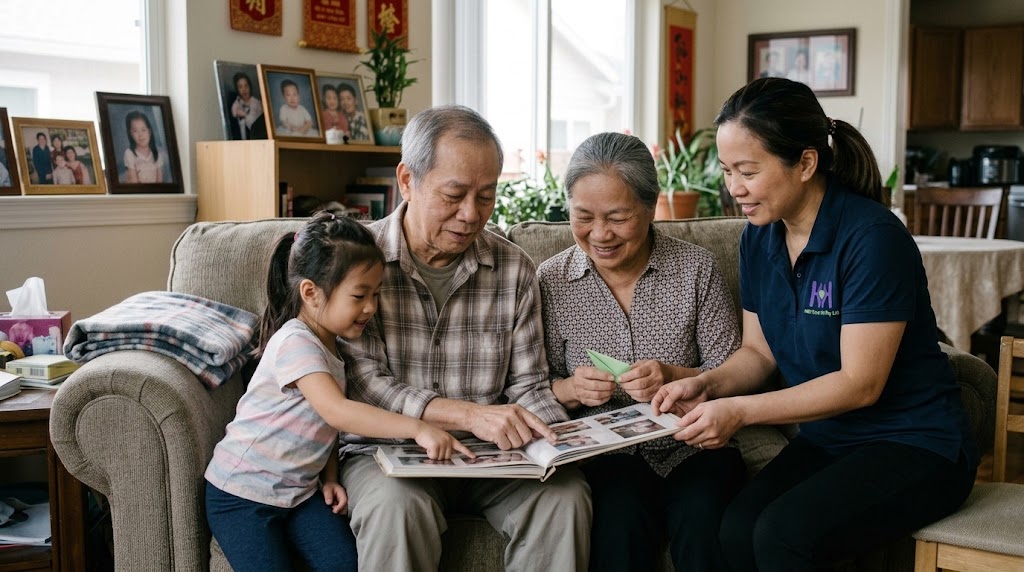
For those of us working in care at H&H Care SA, her story reminds us to notice both the person receiving support and the family member beside them. Completing the tasks in our shift matters. So does noticing the tired eyes, weary steps or smile that may be hiding pain.
We cannot walk the whole journey for her. But we can work thoughtfully, listen closely and help the family share the responsibilities so she has a real chance to rest.
We hope that when she says, “I’ll take care of it,” someone will gently reply, “Let us help today. Take a little time for yourself.”
Caring for Those Who Care: A Director’s Appreciation of Support Workers
As Director of H&H Care SA, I recognise that behind every support worker’s shift is a great deal of effort that often goes unseen. Each day, you care for people with dedication and patience while continuing to build your knowledge and understand the requirements that guide your work. Beyond your shifts, many of you are also studying and caring for your own families.
I believe leadership means listening, understanding and standing beside our staff. When mistakes happen, we should respond calmly, understand the circumstances, address any risks and help people learn—rather than simply blame them. Providing clear guidance, practical training and the resources to work safely is part of my responsibility as a director.
Your dedication deserves respect, encouragement and practical support. I want every member of our team to feel valued, trusted and comfortable asking for help. Caring for our team is also part of caring for the people we support./heading
He Wanted to Keep Living
A personal reflection by Huy Le
He passed away more than a year ago.
Yet whenever I think of him, I can still hear what he said to me in the car that day:
“Please let me eat the sweets. Don’t tell me off. I won’t be able to enjoy them for much longer.”
At the time, I thought it was another of his passing remarks. I turned towards him and smiled.
“You’re always talking nonsense.”
He looked at me and replied quietly:
“I mean it.”
Later, when we learned that he had advanced cancer, I kept returning to that conversation. I do not know whether he had sensed something changing in his body or whether the words had simply come to him. I only know that, since he died, whenever I see the sweets he loved, I think of him.
When we first met, I could never have imagined how deeply I would come to care about him.
He was living in a privately owned motel, arranged as temporary accommodation while he waited for another home. His previous house had been damaged by fire. When I asked what had happened, he answered casually:
“I was bored, so I set it on fire for fun.”
I did not know how much truth there was in that answer and how much was bravado. But the way he said it was enough to put anyone on guard.
He spoke loudly, snapped at people and became angry easily. If someone refused to do what he wanted, he would glare, tense his body and move towards them as though looking for a confrontation. Several care providers had supported him before I met him. Some workers were so frightened that they struggled to maintain the boundaries their work required.
He was living with schizophrenia. Heavy smoking, drinking and cannabis use made his care more complicated. At times, he neglected his personal hygiene and his surroundings almost completely. It was easy for people to see only someone who was difficult to approach and difficult to support.
At first, there were moments when I saw him that way too.
That changed as I came to know him.
One day, he asked me to drive him to visit a friend. He wanted me to drop him at the entrance to a laneway and wait.
Suspecting the purpose of the trip, I asked him directly:
“Are you asking me to take you to buy cannabis? If that’s what this is, I won’t take you.”
He became furious. His face flushed, his fists clenched, and he came straight towards me.
I stood still and looked directly at him.
When his face was almost against mine, his expression suddenly softened. He grinned.
“I was only joking. Why are you being so serious?”
I answered firmly, with words that were quite confrontational too. Looking back, I know that exchange should not be held up as a model for responding to distress in care. At the time, I wanted him to understand that I was there to help him, but I could not agree to everything he asked.
He looked at me for a moment, then smiled.
“I know.”
After that, he became less confrontational with me. We began to be able to talk.
Still, his promises to stop using cannabis rarely lasted. He would catch a bus and buy it without telling me. When he used it and struggled to manage his behaviour or care for himself, we stayed close, watched over him and tried to keep him safe until he settled.
Afterwards, I would talk to him again. He would apologise and promise again.
Then it would happen again.
Sometimes I was frustrated. Sometimes I felt helpless. But through all those conversations, he often said something whose weight I only gradually came to understand:
“I’m so bored. I don’t know what to do all day.”
I asked whether he would like to learn the guitar.
“I’ll buy you one and teach you.”
He was delighted. I bought him a Yamaha classical guitar, hoping it would give him something to look forward to in the afternoons.
He practised a few times, then stopped. The guitar sat there, and our little plan came to an end.
I asked what else he might enjoy.
He told me he had once worked as a chef at a major hotel in Adelaide. That was true. Before illness and upheaval took his life in another direction, he had been skilled at his work and had worked hard in a professional kitchen.
I enrolled him in a cooking course, hoping something familiar might bring him pleasure.
After about three sessions, he cut his hand with a knife. I gave him first aid there and then. After that, he no longer wanted to attend.
Another plan left unfinished.
I did not know whether he stopped because of pain, fear, illness or because it had become too difficult for him to sustain an interest in anything. I only knew that I still wanted to help him find something to do, somewhere to go, a little enjoyment in days that seemed far too long.
Then, one afternoon, he lost his accommodation.
Smoking in his room, scattering cigarette ash and disturbing other guests at night had become more than the motel manager could accept. There were burn marks on the carpet. The manager feared for the safety of the entire building.
I had warned him many times. Eventually, what we had feared happened.
I went there, pleaded and asked for more time. The manager would not change the decision. I understood why, but seeing him standing there with his belongings, I could not simply walk away.
I called his family, housing services and organisations that might help someone facing homelessness. Call after call led nowhere.
As evening approached, I made a decision out of desperation. I took him to the emergency department and described his mental state as more severe than what I had actually observed, hoping he could stay overnight.
I need to be honest about that decision. My fear that he would sleep on the street did not make it right to give an inaccurate account.
When the specialist arrived, he told the truth himself:
“He said that so I’d have somewhere to sleep. I was kicked out because I smoked in the motel.”
I stood beside him, deeply embarrassed. Then I explained everything and asked the hospital to consider his circumstances.
After assessing him, the hospital allowed him to stay for observation and care. Meanwhile, I continued searching for accommodation, knowing I could not expect the hospital to solve his long-term housing needs.
Eventually, after discussing it with his family, I brought him to a house owned by the company.
It was a clean, comfortable four-bedroom home. I set up a table and chairs in the backyard so he would have somewhere to smoke. Before he moved in, I made the rules clear:
“You need to keep the house clean. Absolutely no smoking inside.”
For the first few days, he followed them.
Then his old habits returned. Sometimes he became so intoxicated that he could not care for himself, and staff helped him wash, changed his bedding and cleaned his room. Sometimes I noticed the smell of cannabis inside. At first, he denied it. Later, he stopped hiding it.
He told me:
“Apart from when the workers are here, I’m on my own. I feel so lonely.”
I did not know what I could say that would be enough. The things I could arrange for him—a room, meals, people to support him—had still not filled the emptiness he felt.
Through our conversations, I learned that he had once lived a very different life.
He was the eldest child of a financially comfortable family. His father was educated and had brought the family to Australia in the late 1980s. He was still a growing schoolboy then.
According to what he told me, his father had high hopes for him. But his school results did not meet those expectations. He felt inadequate and carried the sense that he had disappointed his father.
Later, he learned a trade and became a chef at a well-known hotel. He had worked hard. He also spoke about conflict with his supervisors, about leaving his job in anger and returning home to more criticism.
I was not there during those years. Nor do I know when or why his mental illness began. I cannot attribute his illness or the breakdowns in his life to one person or one cause.
But I believe the feeling he described was real: he had often felt that he was not good enough.
His mother regularly sent food. Whenever she had something special, she saved some for him. When she visited, she stayed close and asked how he was.
His father showed his feelings less openly. Father and son often clashed; sometimes they could exchange only a few sentences before the conversation broke down. Yet his father still called me to ask about him.
I believe he loved his son. There were simply things between them that had become difficult to say after so many years.
He continued going out, and some nights he did not come home.
We worried when he did not answer his phone. The next morning, he would reappear and tell us he had slept in a park with people he had met. He proudly described how they had given him food and cigarettes, and even a shirt.
He would take the shirt from his bag, pleased as though he had received something precious.
I would remind him:
“Go out if you want, but come home at night so you can sleep safely.”
“Okay.”
Then he would go again.
Sometimes, listening to him describe people on the street who had shared food, given him a little money or simply sat and talked with him, I began to understand why he kept returning. Those encounters made him feel welcome.
He also had an almost childlike love of sweets.
He could finish a large bag in a day. Whenever I was coming to visit, he would often say:
“Don’t bring too much. Just bring me some sweets.”
Once, I arrived empty-handed. He did not complain, but I could see his disappointment. After that, I brought them again.
I would hand them over and tell him not to eat too many. One day, watching him eat them continuously in the car, I scolded him.
That was when he said:
“Please let me eat them. Don’t tell me off. I won’t be able to enjoy them for much longer.”
One day, he developed a persistent cough, shortness of breath and a mild fever. I took him to hospital.
The following day, the hospital told me that imaging had shown an abnormal mass in his lung. He needed further investigations and a biopsy.
I worried while we waited for the results. He seemed untroubled.
I spoke sharply about his smoking. He replied:
“If I die, the suffering ends. What’s there to worry about?”
Then the results came.
The lung cancer was advanced. Surgery was not possible as we had hoped. Further treatment would need to follow the specialist team’s recommendations.
I felt devastated.
He frowned slightly, said nothing and came home with me.
In the car, I remembered the sweets and what he had said a few weeks earlier. I looked across at him. This time, he was quiet and thoughtful too.
“Are you frightened?”
His answer was the same:
“When you die, that’s it. What’s there to be afraid of?”
Later, I would learn that this was not everything he felt.
I went with him to treatment appointments, specialist consultations and discussions about his illness.
His health declined. The coughing continued, and breathing became harder. Watching him struggle for breath, I felt painfully limited. I could take him to appointments, listen to the clinicians’ advice and work with our staff to care for him each day. I could not take the illness away.
He continued to smoke. Sometimes he still went out to buy cannabis.
I had spoken to him about it so often that there were days when I did not know what more I could say. In the end, we still needed to be there—to watch over him, care for him and ease what suffering we could.
Then a bleeding wound developed on his big toe. Despite daily wound care, it did not heal. I took him back to hospital.
A biopsy showed that the cancer had spread there.
The doctor explained that his illness had progressed and that further cancer treatment was no longer expected to provide the benefit we had hoped for. Care would now focus on relieving symptoms and keeping him comfortable.
I interpreted each part of that conversation for him.
He took my hand.
This time, there was no trace of bravado.
“Tell the doctor I want to keep having treatment. I want to keep living.”
My throat tightened.
The man who had said that death would end his suffering was asking me to help him find another chance to live.
I translated his words. The doctor listened and explained. I understood the helplessness in the doctor’s expression, but it was still hard to accept on his behalf.
Later, he asked me again:
“Please ask the doctor for me. As long as there’s a chance, we should keep trying.”
I could only hold his hand, encourage him to conserve his strength and remind him to tell us whenever he was uncomfortable so we could help.
In his final days, he became much gentler.
During his waking moments, he spoke more clearly. He listened, nodded and quietly agreed. He trusted the familiar staff from our company and wanted them beside him to help with his care.
His family visited more often. His parents, siblings and other relatives came in turn. I could see that he was comforted by having someone sit beside him, ask after him and call him by name.
I do not know what passed through his mind during those hours in bed. But from the way he held my hand and asked me to speak to the doctor, I knew he still wanted to stay.
Later, he slept more, ate less and remained awake for shorter periods.
During one visit, I joked in the familiar way we had come to speak to each other:
“Come on, get up. Get up and have a round with me.”
He gave a faint smile, then closed his eyes.
I stood looking at that smile. Remembering the man who had once squared up to me, I felt only tenderness.
That afternoon, his family came. A Buddhist monk was invited to chant prayers.
His mother leaned close to his ear and whispered:
“Remember to follow the Buddha, my son.”
Tears ran down his face.
I do not know how much he could still hear. When I entered and called his name, he struggled to open his eyes and look at me, then closed them again.
At about four in the morning, my phone rang.
One of my workers said:
“He’s gone.”
I held the phone and sat in silence.
After so many calls about accommodation, appointments and treatment, this was the call I could do nothing to change.
At his funeral, family photographs appeared on a screen.
I was astonished by the young man I saw.
He was handsome, slim and confident. I looked for a long time, trying to connect the young man in those pictures with the person I had cared for in the later part of his life.
I had met him after illness and loss had left so many marks. Those photographs showed me what had come before: he had been young and healthy, with a family, a career and things to hope for.
He had once been married and had two children, a son and a daughter. During the time we supported him, I had met them when they came to visit.
He often spoke about his daughter. Some of what he said was tangled in delusions—stories of great wealth he intended to leave her. I did not know what he had to give. But whenever he spoke about his children, I could hear a father’s love.
At the funeral, both children wept.
Watching them, I grieved for a life that had ended with so much still unsaid.
More than a year has passed, and I still remember him.
I remember the times he made me angry, the calls that worried me, the abandoned guitar lessons, the unfinished cooking course and the shirt he was so pleased to show me.
I remember his request before my visits:
“Just bring me some sweets.”
And I remember his hand holding mine:
“I want to keep living.”
I am not telling this story to judge him or his family. However close we may become, those outside a family cannot know everything its members have lived through. I, too, lost my temper, spoke harshly and made decisions that I must look back on honestly.
But his life leaves me wanting to say something to parents.
Please be compassionate towards your children.
We can have hopes for them, offer advice and help them find their way. But please do not make them spend their lives proving that they deserve our love. Do not insist that they follow a career, attain a particular status or become the person we have already imagined for them.
A child who does not become a doctor, an engineer or someone with an impressive title can still live honourably, master a trade and build a worthwhile life. The chef who prepares a good meal, the tradesperson who makes something sound and lasting, and the worker who earns a living honestly all have something valuable to offer.
Every honest profession deserves respect. Master a craft, and you can build a life with dignity.
When children stumble, please let them know they still have somewhere to return. When they become ill or their lives fall short of our expectations, please continue to see the child we love.
Our advice is more likely to reach them when they know that, even if they choose another path, our love will remain.
I do not know whether his life would have been less painful if things had been different. I have no answer to that.
I only wish that, when he was still healthy, still working and still had many years ahead of him, there had been more moments when he felt understood, proud of his work and loved without needing to become someone else.
Now, whenever I remember him, I see that hand reaching for mine.
And I hear a simple, heartfelt plea:
“Please tell the doctor… I want to keep living.”